The Prop Table Is Not a Filing System
A prop table return-and-reset routine keeps objects ready between scenes, clarifies who handles each one and reduces confusion during a live show.
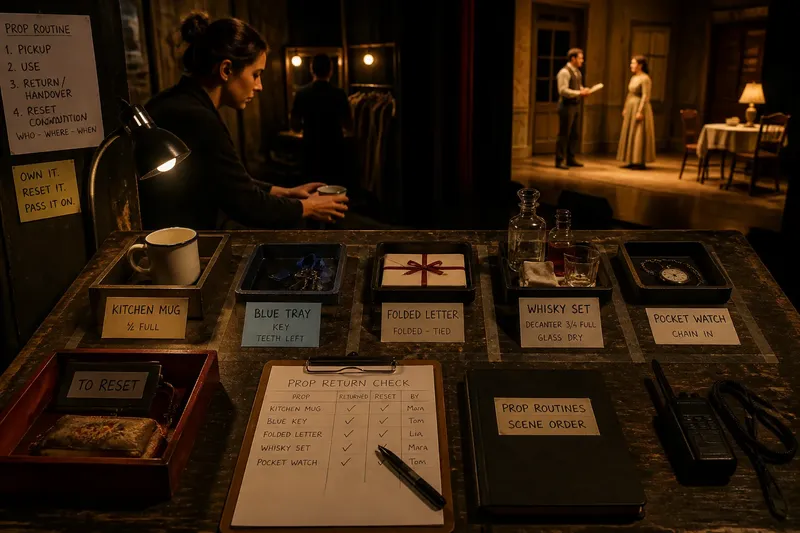
A prop table return-and-reset routine matters more than tidy rows: a cup placed neatly in the wrong place is still missing when the next scene needs it. In theatre, the table is a temporary station in a sequence of actions, not a filing system that can make objects self-explanatory. The useful question is not simply where a prop sits, but who returns it, when it is reset and how the next user can tell it is ready.
Why does a prop table need a routine?
During a performance, props move between the table, performers, wings, set and sometimes the audience. A labelled space can show where an object belongs, but it cannot show whether that object has been used, whether it is ready for the next entrance or who should put it back. Those details live in the routine.
Think of the table as a relay point. Each handover has a beginning and an end: a performer or crew member takes an item, uses it, then returns it or hands it to the next person. If the final part is left implicit, the object may be abandoned on a chair, carried into a later scene or put in a nearby space that looks plausible. The table can remain orderly while the show’s sequence becomes unreliable.
A good routine makes the state of an item legible. “On the table” is not always enough. It may need to be clean, closed, filled, emptied, arranged with another object or placed in a particular orientation. The person preparing the next scene should be able to see whether that work has happened without having to reconstruct what the previous scene did.
What does “return and reset” mean?
Return means bringing a prop back to its assigned home or passing it directly to the next person who needs it. Reset means restoring it to the condition required for its next use. The same action can do both, but they are separate checks: a mug can be returned to its place while still holding the wrong amount of liquid, for instance.
For each prop, the company needs a shared answer to four practical questions:
- Who takes the prop, and from where?
- Who receives it after use, or where does it go?
- What condition must it be in before its next use?
- When should the return and reset happen in the scene sequence?
Answers should be concise enough to use under pressure. “Mara returns the key to the blue tray after the doorway scene” is more useful than “key back”. If the key must also be turned to a particular side or paired with a tag, include that in the reset note. Avoid adding detail that no one needs to act on.
How can you map a prop’s journey?
Start with the script and the actual staging, not with a decorative layout. Mark each appearance of a hand prop and note who handles it, where it enters the action and where it goes afterwards. Stage directions may suggest a movement, but rehearsal can reveal a different handover or a new place where an object is set down. The working routine should reflect what performers and crew actually do.
A simple prop journey has three points: pickup, use and return or handover. Add a reset condition only when the next use requires one. This keeps the plan readable while catching the details most likely to cause a mismatch.
Say a performer takes a folded letter from a side table, opens it during a scene and hands it to another performer, who exits with it. Imagine the next scene needs the same letter already folded on a chair. The routine must say who retrieves it after the exit, where it is refolded and who places it on the chair before the next entrance. A neat outline of the side table will not answer those questions.
For objects that pass directly from one scene to another, a hand-to-hand transfer may be more dependable than a trip back to the prop table. If a prop changes hands in view of the audience, the handover can be part of the staging; if it changes backstage, name the person who receives it. Choose the route that fits the production’s traffic and makes responsibility clear.
How should the table make the routine visible?
Once the route is known, arrange the table to support it. Keep items with related handling needs together, but do not let visual neatness override the route of the show. A prop used for a later scene should not occupy the easiest pickup position if that encourages the wrong person to take it early.
Use clear, stable labels for assigned spaces. A removable label, a simple outline or a tray can mark a home; a separate note can state the reset condition. Avoid relying on colour alone, since lighting, rushed attention or a change of crew can make colour cues hard to distinguish. The layout should help someone find the correct place, while the routine explains what must happen there.
Keep a distinction between props that are ready and props that have been returned but still need attention. A clearly marked “to reset” area can help if the production has enough space and someone is assigned to clear it. Otherwise, a short verbal handover or a written tick-off beside the prop’s name may work better. Do not create a status system that takes more time to maintain than the reset itself.
For small or similar-looking items, give each a recognisable home rather than laying them in a row that depends on memory. Two identical envelopes, for example, may need separate labels for different scenes. The distinction can be as modest as a discreet mark on the reverse or a labelled tray compartment, provided it is permitted by the design and does not show to the audience.
Who owns each return and reset?
Responsibility should be assigned to a person, not to a vague group. “The cast puts everything back” leaves room for each performer to assume someone else will do it. A named prop handler, performer or crew member can take ownership, while another person may verify a critical reset if the production calls for that extra check.
Assigning responsibility does not mean making every performer carry out every reset. One person may be best placed to recover props from a wing, while the performer who used an item is best placed to hand it over. The routine can split those actions, as long as the handover is explicit: one person passes the prop, and the next person acknowledges receipt or places it in its assigned home.
Make the routine visible in rehearsal. Walk the route at the pace the scene requires, including the moment when a performer exits or another scene is being prepared. If a person must cross a busy path, reach through a costume change area or wait for a prop that is still in use, adjust the route or timing. A plan that works only when everyone pauses is not a useful performance routine.
What changes when props are shared or reset under pressure?
Shared props need particular care because more than one person may assume the other has returned them. Name the handover point and the next user. When a prop is used in quick succession, it may be better to pass it directly rather than return it to the table and retrieve it again. That choice should be rehearsed so it does not create an unexpected crossing or distract from the action.
Some props require a condition check as well as a location check. A paper item may need to be folded; a container may need to be emptied; a hand-held object may need to be placed with its working side facing the performer. Keep reset requirements specific to the object and its scene. If a change could affect safe handling, follow the relevant manufacturer instructions, production procedures and local rules, and consult a qualified professional where appropriate.
Build in a sensible response for a missed return. The company should know where to look first and who has authority to make a substitute arrangement, rather than having several people search or improvise different versions. For a harmless duplicate, a designated spare may be practical; for a unique or story-critical object, the response may instead be a quick call to the person responsible. The plan should suit the prop’s role and the production’s constraints.
Which prop-table questions should the company settle?
Should every prop have its own labelled place?
Give recurring or easily confused props a clear home, especially when their scene or user matters. A bulky object used only once may be better kept in its practical staging position, with its route noted, rather than forced onto a crowded table.
What if the next scene needs a prop before it can be reset?
Change the route, timing or handover so the reset happens before the next pickup. If no one can prepare it in time, the staging or prop arrangement may need revision rather than a silent assumption that it will somehow be ready.
Is a written prop list enough?
A list can record the prop, user and home, but it rarely captures the whole action by itself. Add brief notes for handovers, reset conditions and timing, then confirm those details in rehearsal.
How can the routine adapt after a staging change?
Update the route as soon as a change affects a pickup, handover or return. Tell the people responsible, then run the altered sequence so the new instruction becomes part of the company’s shared practice rather than an isolated note.
How can the routine stay useful through the run?
Keep the prop record close to the table and make revisions easy to spot. A concise list can include the prop name, scene or cue, user, return point and reset condition. When a change is made, remove or amend the outdated instruction rather than leaving conflicting notes for the next person to interpret.
Check the routine during ordinary rehearsals and again when the space, cast or backstage traffic changes. The aim is not to inspect every object continually; it is to notice whether the handovers still match the action. A brief check after a sequence can catch a recurring ambiguity while there is still time to clarify it.
The prop table works best when its layout and its routine agree: the table shows where an object belongs, and the return-and-reset practice shows how it gets there ready for the next scene. Treat the table as a handover point, not a filing cabinet, and each prop’s next use becomes easier to prepare for and easier to trust.