A Calm Plan for the Final Week Before Opening
A final week before opening checklist helps a theatre team close open tasks, confirm handoffs and protect time for a complete run-through.
A final week before opening checklist is most useful when it closes decisions rather than creating new ones. In a theatre production, the last days can fill quickly with small requests, unfinished handoffs and pressure to polish everything at once. A calm plan gives the company a shared view of what must be completed, who owns it and when the work stops so the final run-through can happen.
What belongs on a final week before opening checklist?
Include only outstanding tasks that affect the agreed production: an unresolved cue, a missing costume item, an incomplete programme detail, a sign-off or a handoff that has not been confirmed. The checklist is not a place to collect attractive new ideas. If a suggestion would alter the staging, design or performance without solving a defined problem, record it separately for later consideration rather than adding it to the week’s work.
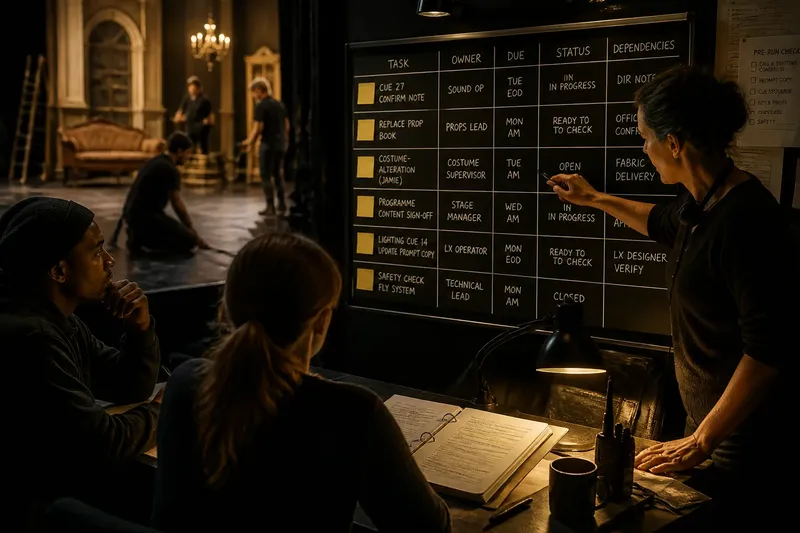
Give every item a clear owner, a next action and a point at which it can be checked. “Finish sound” is too broad to assign usefully. “Sound operator confirms the approved cue sequence with the stage manager” identifies both the responsibility and the evidence of completion. Keep the list in one shared place, such as the production office board or the team’s established digital document, so people are not reconciling competing versions.
- Outstanding task and the specific action that remains.
- One named person responsible for moving it forward.
- Who needs to receive or approve the result.
- When the result must be ready for checking.
- A status such as open, in progress, ready to check or closed.
- Any dependency that could prevent another person from proceeding.
These entries make the checklist useful without turning it into a second schedule. A task can be complete for one department but still awaiting a handoff; mark that distinction plainly. The list should show the state of the work, not imply that a person has failed because a dependency is unresolved.
How should the team decide what is still essential?
Use the production’s existing decisions as the boundary. Ask whether an open item is needed for the show to run as agreed, for a performer or crew member to work safely, or for an audience-facing commitment to be met. If it does not affect one of those things, it may be a refinement rather than an opening requirement.
That distinction reduces late-week churn. A request to adjust a costume fastening because it obstructs a performer’s movement is different from a request to change its appearance because someone has thought of another option. The first has a defined practical problem; the second may introduce more fittings, approvals and knock-on work. Keep the focus on resolving known needs, not generating fresh production ideas.
When an item is disputed, ask the relevant department lead and stage manager to state the problem in observable terms. “The transition is confusing” needs clarification: is a performer missing a cue, is an object not reaching its next position, or is the audience unable to follow the change? A specific problem can be checked in rehearsal. A vague preference tends to invite repeated discussion without a useful stopping point.
How can handoffs be confirmed without adding meetings?
A handoff is complete when the recipient has the information or item needed to continue, not merely when the sender has finished their part. Confirm it in the channel the team already uses: a brief message, an updated running document, a note on the prompt copy or a direct acknowledgement at the relevant call. Avoid calling a meeting simply to announce work that can be confirmed clearly in writing.
State what has changed, where the current version lives and what response is needed. For example, a props lead might tell the stage manager that an approved replacement item is in its assigned place and is ready to be checked at the next call. That is more useful than “props sorted”, which leaves the recipient unsure what changed or whether any action remains.
Think of a handoff like passing a labelled key: the person receiving it needs to know which door it opens and whether it is ready to use. In production terms, a lighting cue update should identify the cue and the current prompt-copy reference; a costume alteration should identify the performer and whether a fitting or movement check remains. Where completion depends on manufacturer instructions, a product label or local rules, follow those requirements rather than improvising a workaround.
What should the daily check-in cover?
A short check-in should surface blockers, decisions and changes in priority. It does not need to rehearse every department’s activity. Ask each owner to report what remains, what they need from someone else and whether the expected check point still looks workable. If an item is already closed, leave it closed unless new information has changed the situation.
Say you are the stage manager and the sound operator is waiting for an agreed cue note from the director. Record the note as a dependency, ask the person who can resolve it to respond by the next suitable check-in, and keep unrelated cue work moving. The observable result is that the team knows what is blocked and who can unblock it, without turning the whole list into a general discussion.
Close each check-in by naming any changed owner or deadline and removing resolved blockers from the active list. If two tasks compete for the same person’s time, make the priority explicit with the relevant leads. Quietly assuming that both can be completed invites a last-minute surprise; a clear decision gives everyone a workable basis for the remaining calls.
How do you protect time for the final run-through?
Put the final run-through into the working plan as protected time, not as the empty space left after other work expands. Tell department leads what must be ready before it begins, and set a point after which non-essential changes wait. The run-through is a chance to see the agreed production operating as a whole, so its value depends on continuity rather than on fitting in another round of unrelated adjustments.
Before the run, confirm the essentials with the people responsible: performers know the call and starting conditions; the stage manager has the current prompt materials; operators have the agreed cue sequence; and required set, costume and prop elements are available in their established places. These are confirmations of existing decisions, not invitations to redesign them. If a practical issue prevents the run from proceeding, decide whether it must be resolved immediately or can be documented for a later check.
During the run, keep notes specific and limited to matters that affect the agreed show or its reliable operation. Record the point where an issue occurs, what is observable and who needs to follow it up. Avoid stopping repeatedly for a preference that can be assessed afterwards; constant interruption makes it harder to judge how the production works from beginning to end.
What if an unfinished task cannot be closed?
Do not disguise an open item as complete. Record what remains, who owns the next action and what decision is needed to keep the production moving. Then distinguish a genuine opening requirement from work that can wait. If the issue affects safe working conditions, consult the appropriate qualified person and follow the relevant venue procedures; do not ask the team to accept an unsafe compromise to preserve the schedule.
For other unresolved items, agree on a practical next check and make the consequence visible. A missing approval, for instance, may mean a department cannot use a proposed version; the production can either obtain the approval through its established route or retain the already approved version. The important point is that the team knows which version is current and what would need to change before that decision is revisited.
A calm final week does not require every small preference to be settled. It requires the company to recognise what is open, complete the handoffs that matter and protect the run-through from avoidable disruption. Keep the final week before opening checklist brief enough to use, precise enough to act on and firmly tied to the production the team has already agreed to make.